
'The unfolding events indicate a dangerous internal security situation in Manipur and the region. It can have external ramifications also.'


US President Donald Trump has repeated his claim that Washington got involved with India and Pakistan, saying he didn't like what was happening and that he did a good job as he convinced the two countries to let's have peace and let's go and make trade deals.
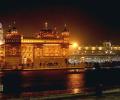
The Army on Monday showcased a demonstration of how Indian Air Defence systems, including AKASH missile system, L-70 Air Defence Guns, saved the Golden Temple in Amritsar and cities of Punjab from Pakistani missile and drone attacks.
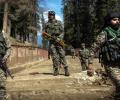
'If there is a military standoff eyeball to eyeball on the western border, the Chinese could create problems by making movements in the north, in our northeast, which could involve us tying down some forces there so that could stretch our military actions.'

'Still, people are asking why we have not gone for a full-out war. As a military man, if ordered, I will go to war, but that will not be my first choice'
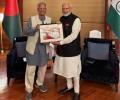
In his first meeting with Bangladesh Chief Adviser Muhammad Yunus, Prime Minister Narendra Modi on Friday flagged concerns over the attacks on minorities, including Hindus and conveyed that any rhetoric that vitiated the environment was best avoided.
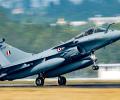
'We will see whether there were losses or not, and whether the war aims were achieved. When the truth comes out, some may well be surprised,' says Dassault CEO.
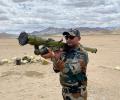
The new supplies of the Igla-S air defence missiles have been received by the Indian Army a couple of weeks ago and are being provided to the forward formations for taking care of the threat from enemy fighter aircraft, choppers and drones on the borders.
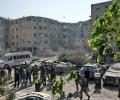
At the end of the day, for many worldwide, the ongoing mutual attacks between Israel and Iran would seem a contest devoid of any moral high ground and only a bout between two ordinary adversaries, one that nevertheless risks spinning out of control into a larger conflagration, notes Shyam G Menon.
It also noted that under the leadership of Prime Minister Narendra Modi, India is more likely than in the past to respond with military force to Pakistani provocations.
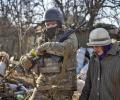
India has repeatedly called on Russia and Ukraine to return to the path of diplomacy and dialogue and end their ongoing conflict.
He said that the two nations will have issues in the foreseeable future. However, there are ways of addressing those issues and what happened in 2020 was not the way to address those issues.

Elon Musk's Starlink has got licence for satcom services in India, according to sources.
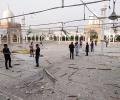
'The Pakistani State has to realise that the pigeons have come home to roost.'

'There's a lot of sense in what Prime Minister Modi did, but the Indian government has to be really prepared for a really sharp escalation spiral.'
GPS spoofing is considered to be a form of cyber attack that includes generating false GPS signals. The false signals result in misleading the navigation equipment which creates a significant risk to aircraft.

'Even known names and social media handles went berserk by stating that Karachi has been attacked and an F-16 was shot down.'

While six of them have been held from Punjab, five were nabbed from neighbouring Haryana, and one from Uttar Pradesh.
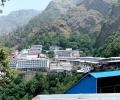
As we continue our climb, I meet 59-year-old Pushpa Devi from Banaras. I stare at her in wonderment when she tells me this is her 45th visit to the temple. She is equally bewildered to hear this is my first visit!What is it that draws her here each year? 'Bas ek shabd hai. Shraddha. (There is just one word. Faith.)'

'If inner line permit was in place in Meghalaya, the details of the three people who allegedly murdered Raja would have been on record.'
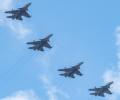
Pakistani military targets at Rafiqui, Murid, Chaklala, Rahim Yar Khan, Sukkur and Chunian were engaged using air-launched precision weapons from Indian fighter jets and the retaliation largely focused on command and control centres, radar sites and weapon storage areas, Qureshi said.

India and China have agreed to work towards a "roadmap" for rebuilding mutual trust following the border standoff in eastern Ladakh, according to a statement from the Indian Defence Ministry. Defence Minister Rajnath Singh met with his Chinese counterpart Dong Jun in Vientiane, Laos, on the sidelines of a regional security conclave. Singh called for drawing lessons from the "unfortunate border clashes" of 2020 and emphasized the need for cooperation rather than conflict. Both sides agreed to work towards a roadmap for rebuilding mutual trust and understanding, and a meeting of the Special Representatives and Secretary-Vice Minister mechanism will also take place soon.

It is time for India to raise its voice not just through military prowess, but through professionalism, principled voting and partnerships, asserts Deepak Mishra.

'The lesson Beijing would have learned is that there is, cost-benefit wise, no better option than to keep the Pakistan military supplied with its most advanced armaments, certain that in hostilities with India these would be used for maximum effect.'

'It brings precarious peace because the red lines have shifted. 'The next Pahalgam attack would mean a full scale war.'
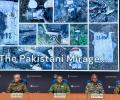
'I'm not accepting the 'any act of terrorism is an act of war' threshold.' 'I don't think this is sustainable because if you do this four or five times in a short duration, it will lose its edge.'

Badar Khan Suri, an Indian postdoctoral fellow at Georgetown University, is facing deportation after US authorities accused him of "spreading Hamas propaganda" and having "close connections to a suspected terrorist." The Department of Homeland Security claims Suri has been actively promoting antisemitism on social media and is connected to a senior Hamas advisor. Suri's lawyer, Hassan Ahmad, argues that his client is being targeted due to his wife's Palestinian heritage and their opposition to US foreign policy towards Israel. The incident follows the self-deportation of another Indian student from Columbia University who was also accused of supporting Hamas.
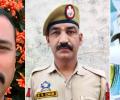
Balwinder Singh Chib, a police officer in Jammu and Kashmir's Kathua district, was killed in an encounter with Pakistani terrorists, continuing a legacy of sacrifice that spans three generations of his family. Chib's great-grandfather and uncle were also martyred in the line of duty, and his brother died during World War I. The family is venerated in their village for their history of patriotism and sacrifice.
'India has been preparing for the last 15 days... it won't be easy for Pakistan if it tries to dominate escalation.'

High-pitched identity politics, which is the norm in the northeast, has continued to compound the boundary problem.

The move came against the backdrop of Turkiye backing Pakistan and its condemnation of India's strikes on terror camps in the neighbouring country and Pakistan-occupied Kashmir under Operation Sindoor.
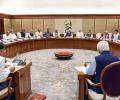
India has reached out to key global powers, including members of the UN Security Council, and apprised them about the reasons behind its military strikes on nine terror targets in Pakistan and Pakistan-occupied-Kashmir in retaliation for the Pahalgam terror attack. New Delhi also conveyed to the countries that it will retaliate if Islamabad escalates the already tense situation.
The UN Security Council could meet soon to discuss the situation between India and Pakistan, with the UNSC President expressing concern over rising tensions between the nuclear-armed neighbors. The President, Ambassador Evangelos Sekeris of Greece, said a meeting would provide an opportunity to express views and help diffuse tensions. Sekeris also condemned terrorism in all its forms, including the recent attack in Pahalgam, and called for de-escalation and dialogue between India and Pakistan.
'A man with a gun commanded respect. I thought if I also got a gun, I could save my family. With this thought, I went to Pakistan and got training there'
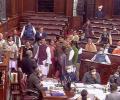
While Chairman Jagdeep Dhankhar repeatedly appealed to the protesting members to take their seats, the unrelenting MPs continued to raise slogans.

"Bangladesh does want war," home minister Asaduzzaman Khan Kamal told reporters in Dhaka when asked for comments on the Myanmar security forces actions on the borders, frightening both Bangladeshis and Rohingyas who took refuge in makeshift camps in the neighbourhood.
'That is why I'm extremely concerned when India says that every terrorist incident in future from Pakistan will be treated as an act of war.'
'I am worried that Pakistan will still feel compelled to take substantive military action beyond this apparent drone activity.' 'If so, the crisis could persist for a while more and dangerous days are still ahead.'

On the eve of the Diamond League in Doha, the two-time Olympic medallist and reigning world champion, sought to set the record straight when asked about his equation with Nadeem, who won the gold medal at the Paris Games last year.
